Sunday, 28 April 2013

Item Club predicts rise in lending to UK businesses

Bank lending to UK businesses will rise in 2013, the first increase for four years, the Ernst & Young (E&Y) Item Club has predicted
The forecasting group's financial services outlook estimates that lending will rise by 3% to £440bn this year
The report says this year's increase is being led by the commercial banks having better access to wholesale funding, and a fall in bad debts.
This year's predicted rise follows after a fall of 5% in 2012.The report also said that the government's Funding for Lending Scheme was making a "material difference".
Lending to firms fell by 5% last year
'Encouraging lending'

Under the FLS scheme, the Bank of England allows the banks and building societies to lend more cheaply, on the condition that they pass on the funds to customers, both businesses and consumers, in the form of cheaper loans and mortgages.
Last week it was announced that FLS would be extended by another year to 2015. The Bank of England also confirmed that non-bank lenders would be able to participate.
Andy Baldwin, head of financial services in Europe at E&Y, said: "Behind the scenes, banking fundamentals have quietly been improving and banks are now in a better position to be able to provide funds to the wider economy.
"Our analysis suggests the main drivers of banks' return to lending will be better access to wholesale funding and a decrease in non-performing loans, rather than the Funding for Lending Scheme making a material difference.
"That said, the scheme is making a contribution in shifting emphasis and encouraging lending expansion across the sector while also helping to restore confidence and stimulate demand from consumers and SMEs [small and medium businesses] alike."
Azure is led by experienced Chartered Accountants and business advisers and specialises in providing online accountancy services to owner managed businesses.Azure Global’s vision is to be widely recognized as a reputed firm of financial business advisors, achieving real growth for ambitious companies and to become the first choice for F&A outsourcing for accountancy practices and businesses alike for more info visit our site Azure Global and join us On Facebook
Article Source : http://www.bbc.co.uk

UK economy avoids triple-dip recession

The UK economy has avoided falling back into a recession after recording faster-than-expected growth in the first three months of the year.
The Office for National Statistics said its first estimate for gross domestic product (GDP) showed the economy grew 0.3% during the first quarter of 2013.
Chancellor George Osborne said it was an "encouraging sign".
 But the shadow chancellor, Ed Balls, said that the economy was "just back to where it was six months ago".
The growth in GDP means the economy avoided two consecutive quarters of contraction - the definition of a recession. There had been fears the UK would enter its third recession in five years, a so-called triple-dip recession.
Economists say the news should give a small psychological boost to consumers and businesses, but the broader picture of the economy remains the same.
The UK economy has been on a plateau since the financial crisis hit in 2008, with small spurts of growth and contraction.
'Making progress'
The better-than-expected rise in GDP for the first quarter was largely down to strong growth in the services sector and a recovery in North Sea oil and gas output.
The ONS figures also showed that GDP had risen by 0.6% when compared with the first quarter of 2012, the strongest year-on-year increase since the end of 2011.
Chancellor George Osborne said: "Today's figures are an encouraging sign the economy is healing. Despite a tough economic backdrop, we are making progress. The deficit is down by a third, businesses have created over a million and a quarter new jobs, and interest rates are at record lows.
"We all know there are no easy answers to problems built up over many years, and I can't promise the road ahead will always be smooth, but by continuing to confront our problems head on, Britain is recovering and we are building an economy fit for the future," he added.
Matt Basi, from CMC Markets UK, said: "Growth of 0.3% is hardly cause for celebration, but may ease some of the pressure that has been piling on the government's austerity plans."
The chancellor has faced calls from the International Monetary Fund to rethink the pace of the austerity programme.
But the government insists its austerity measures are vital to bringing down borrowing, and guarantee growth in the long-term.
Poor growth has already led to two international credit rating agencies stripping the UK of its   top-notch triple-A rating.
Shadow chancellor Ed Balls said: "If we're to have a strong and sustained recovery, and catch up all the ground we have lost over the last few years, we need urgent action to kick-start our economy and strengthen it for the long-term - as Labour and the IMF have warned."
He added: "We need radical bank reform and a jobs and growth plan, including building thousands of affordable homes and a compulsory jobs guarantee for the long term unemployed. And instead of a tax cut for millionaires, we need a lower 10p starting rate of tax to ease the squeeze on millions of people on middle and low incomes."
Strong services
The pound rose nearly 1% to $1.5414 against the US dollar on the news, its highest point in two months.
The services sector, which accounts for three-quarters of the economy, grew by 0.6% in the quarter, with a strong performance from hotels and restaurants.
Transport and communications also made a solid contribution with growth of 1.4%.
But there were some areas of continuing weakness. Construction activity fell 2.5% in the first quarter and remains more than 18% lower than it was before the start of the financial crisis in 2008.
Phil Orford, the chief executive at the Forum of Private Business said: "While the service sector looks to have led the way, the construction industry figure is more worrying, and shows the need to get projects moving at a quicker pace."
Vicky Redwood, UK economist at Capital Economics said the recovery still faced "significant obstacles ahead, with households still experiencing falling real pay and policymakers still struggling to get bank lending to rise".
"Today's figure offers some hope that things might finally be starting to move in the right direction again," she added.
The economy has still not recovered from what has been the longest and deepest recession in modern history.
Overall the size of the economy as a whole remains 2.6% smaller than its pre-recession peak. Its pace of growth has also been much slower and weaker than in previous recessions in the UK.
Azure is led by experienced Chartered Accountants and business advisers and specialises in providing online accountancy services to owner managed businesses.Azure Global’s vision is to be widely recognized as a reputed firm of financial business advisors, achieving real growth for ambitious companies and to become the first choice for F&A outsourcing for accountancy practices and businesses alike for more info visit our site Azure Global and join us On Facebook
Article Source : http://www.bbc.co.uk

Universal credit: Major benefits shake-up begins

A massive shake-up in the UK benefits system starts on Monday, with the first claims being made for a new universal credit payment.

Universal credit will merge several benefits and tax credits into one monthly payout.
It begins with a very small number of new claimants in Ashton-under-Lyne in Greater Manchester, but will eventually affect nearly six million people.
Those who are looking for work will receive the new universal credit
 The system relies on a complex computer system, with claims made online.
  Simplification
The benefit is for working age people looking for work, and will replace income-based jobseeker's allowance, income-related employment and support allowance, income support, child tax credit, working tax credit, and housing benefit.
It is the central plank of a benefits overhaul, championed by Work and Pensions Secretary Iain Duncan Smith, which the government says will mean people are always better off in work than on benefits.
It is also designed to simplify the welfare system by bringing a number of benefits together and reducing fraud and error.
However, some groups have raised concerns that the system is entirely dependent on a complex computer network which may not be ready or able to cope with millions of claims. They are also concerned that many potential claimants do not have access to the internet.
Online claims
The key features of universal credit include:
  • A single, monthly payment which the government says mirrors the world of work, but charities say could create problems for personal money management
  • The inclusion of financial help to pay rent, which is currently paid directly to landlords
  • An online-only claiming process, with accounts also managed online
  • The benefit paid to households, rather than individuals, and put straight into bank accounts
  • Benefits automatically adjusted depending on earnings, which employers enter into a computer system called real-time information
This means that there will no longer be a ceiling of 16 hours of work a week, below which people can sign on and above which claims are cancelled.
This is set to benefit people like Darren Bailey, an agency worker, whose working hours fluctuate, meaning he has to keep making claims under the current system.
"I have five kids so I can't afford to mess about," he said. "Any system has got to be better than this system."
Budgeting
The government estimates 3.1 million households will be entitled to more benefits as a result of universal credit, while 2.8 million households will be entitled to less.
Across all households, ministers say there will be an average gain of £16 per month. The long-term cost to the government is £100m in current prices.
The only claimants to receive universal credit in the initial stages will be single, new claimants at a jobcentre in Ashton-under-Lyne.
Three other pilot projects - in Warrington, Oldham, and Wigan - have been delayed until July.
From October, newly unemployed people will make claims under the new system. Current benefits and tax credits will gradually be shifted to universal credit from spring 2014, with the whole process completed by 2017.
Iain Duncan Smith said at the weekend that universal credit was being introduced over a four-year period because "I want to get these things right".
He added: "We want to say to people, you're claiming unemployment benefit but you're actually in work paid for by the state: you're in work to find work. That's your job from now on: to find work."
All claims for universal credit will need to be made online
 Labour's Shadow Work and Pensions Secretary Laim Bryne said that universal credit was "a fine idea that builds on Labour's tax credits revolution".
Yet he added: "The truth is the scheme is late, over budget, the IT system appears to be falling apart and even DWP [Department of Work and Pensions] ministers admit they haven't got a clue what is going on."
Benefits and grants charity Turn2us said that 43% of people whose benefits would be replaced by universal credit were not aware of the change.
"Once you look at the nuts and bolts, budgeting is not going to be easy especially for those with a small amount of money," said Alban Hawksworth, welfare benefits specialist at the charity.
Azure is led by experienced Chartered Accountants and business advisers and specialises in providing online accountancy services to owner managed businesses.Azure Global’s vision is to be widely recognized as a reputed firm of financial business advisors, achieving real growth for ambitious companies and to become the first choice for F&A outsourcing for accountancy practices and businesses alike for more info visit our site Azure Global and join us On Facebook
Article Source : http://www.bbc.co.uk


Bank lending to UK businesses predicted to rise in 2013

The Ernst & Young ITEM Club expects lending to grow by 3% to £440bn this year, and by 8.5% to £447bn in 2014

Bank lending to UK businesses will go up this year for the first time in four years as economic growth picks up, according to an influential forecasting group, in a boost to government attempts to kickstart a flatlining economy.
The prediction comes after the Treasury and Bank of England extended the £80bn Funding for Lending scheme in an attempt to boost support for small businesses, which are still struggling to borrow.
Lending is expected to grow by 3% to £440bn this year, and by 8.5% to £447bn in 2014, according to a report published on Monday by independent forecaster the Ernst & Young ITEM Club. The news is a further boost to George Osborne after the chancellor escaped the ignominy of a triple-dip recession last week with the publication of official figures that showed GDP growth of 0.3% in the first quarter of 2013.
The flow of money towards British business in the ITEM report would be a dramatic reversal of last year's crackdown on credit, which saw lending to corporates shrink 5%, hitting the lowest level since 2006.
"You might be forgiven for thinking we were still in the midst of the banking crisis," said Andy Baldwin, head of financial services in Europe at Ernst & Young. "But behind the scenes banking fundamentals have quietly been improving and banks are now in a better position to be able to provide funds to the wider economy." Nonetheless the optimism of the ITEM forecast is at variance with some of the Bank of England's own soundings, which show that small firms are still faced with a tough lending environment.
The main drivers of banks' return to lending would be better access to wholesale funding and a decrease in bad loans, Baldwin said, rather than any marked impact from Funding for Lending, which was launched by the Bank of England last year but has failed to have a marked impact on business lending.
A fall in money lost to bad loans is also helping to rebuild confidence. Write-offs are forecast to fall to £9.3bn, just 0.56% of all borrowing this year, after peaking in 2013 at £11.6bn.
However, even minor changes to the UK interest base rate could push many companies into bankruptcy, the report's authors warn. The Bank of England has held rates at a record low of 0.5% for four years, helping businesses and home owners stay solvent.
The Ernst & Young ITEM club's prediction follows the Bank of England's extension of its Funding for Lending scheme
Banks have been more lenient than in previous recessions, allowing weaker loans to continue rather than foreclosing. Many companies being kept afloat are simply able to service their debts and are unable to invest or expand.
"It wouldn't take a significant shift in interest rates to increase the repayment burden of families and businesses across the UK, at great social cost and with a detrimental knock on effect on lending," said Baldwin.
ITEM is the only non-governmental forecaster to use the Treasury's model of the UK economy. It also consults a network of company executives, from a range of corporate life including FTSE companies and small-sized firms. According to ITEM, economic growth will be modest, with the UK economy growing 0.9% in 2014.
The Bank of England, which administers the Funding for Lending scheme, will be extending it for a year until January 2015, and it will offer lower interest rates to lenders who can prove they are extending credit to small businesses.
The senior economic adviser to the ITEM Club, Carl Astorri, said the upbeat outlook reflected the fact that company executives are coming to terms with an uncertain business environment, where the implosion of the eurozone and the Chinese economy is a constant but so far unrealised threat.
"Things like the eurozone collapse, the Chinese hard landing or sequestration in the US have been prevalent when we speak to top chief executives and chief financial officers. But increasingly they are less fearful and are becoming used to operating in an environment where those risks exist."
The ITEM Club's optimism comes despite a more cautious assessment of the business lending environment from the Bank of England. In its agents' report for April, which gauges the economic environment around the UK, the bank says firms are "relatively positive" about their likely use of bank borrowing over the next 12 months.
In a survey of 370 firms, the bank said large companies had seen an improvement in availability of credit but small firms, classified as businesses with a turnover below £1m, had seen a deterioration in the availability and cost of loans. Medium-sized companies said access to borrowing was easier, but more expensive.
Azure is led by experienced Chartered Accountants and business advisers and specialises in providing online accountancy services to owner managed businesses.Azure Global’s vision is to be widely recognized as a reputed firm of financial business advisors, achieving real growth for ambitious companies and to become the first choice for F&A outsourcing for accountancy practices and businesses alike for more info visit our site Azure Global and join us On Facebook
Article Source : http://www.guardian.co.uk

Friday, 26 April 2013

MPs criticise accounting firms on tax avoidance

Corporate tax avoidance has risen to the top of the political agenda in Britain in the past year following reports which showed some major companies paid little or no tax in the country by shifting profits to tax havens.
While the four biggest accounting firms, KPMG , Deloitte , Ernst & Young and Price water house Coopers said they no longer advised on aggressive tax avoidance plans, the Public Accounts Committee said: "They are still devising complex schemes that look artificial".

It went on to say the accounting firms were still prepared to recommend tax arrangements which had as little as a 50 percent chance of being successful if challenged in court.
The report also questioned the way staff from the "Big Four" were seconded to the government to help draft tax rules.
"The large accountancy firms are in a powerful position in the tax world and have an unhealthily cosy relationship with government," Committee chair Margaret Hodge said.
But the firms said they behaved ethically and that the complexity of tax law was largely to blame for any appearance to the contrary. They welcomed the committee's calls for the rules to be simplified.
"We perform an essential function in the UK economy by helping our clients navigate this complexity," Bill Dodwell, Head of Tax Policy at Deloitte said.
The committee called on companies to disclose more information about their tax affairs. The government has also called for more disclosure but has said it wants this to be done on a voluntary, rather than a mandatory, basis.
Azure is led by experienced Chartered Accountants and business advisers and specialises in providing online accountancy services to owner managed businesses.Azure Global’s vision is to be widely recognized as a reputed firm of financial business advisors, achieving real growth for ambitious companies and to become the first choice for F&A outsourcing for accountancy practices and businesses alike for more info visit our site Azure Global and join us On Facebook
Article Source : http://uk.reuters.com


UK avoids triple-dip recession with better-than-expected 0.3% GDP growth

George Osborne says growth is evidence the coalition's policies are helping to 'build an economy fit for the future'

George Osborne has welcomed news that Britain's economy expanded by a stronger-than-expected 0.3% in the first quarter of 2013, avoiding a triple-dip recession.
As the first estimate from the Office for National Statistics showed that a healthy performance from the services sector helped GDP growth to beat the 0.1% expected by City pundits, the chancellor said it was evidence that the coalition's policies were helping to "build an economy fit for the future".
"Today's figures are an encouraging sign the economy is healing," he said. "Despite a tough economic backdrop, we are making progress. We all know there are no easy answers to problems built up over many years, and I can't promise the road ahead will always be smooth, but by continuing to confront our problems head on, Britain is recovering and we are building an economy fit for the future."
The key services sector expanded by 0.6% on the quarter, according to the ONS, while industrial production also grew, by 0.2% – though much of that was accounted for by North Sea output. The struggling construction sector declined by 2.5%.
The business secretary, Vince Cable, said: "Today's figures are modestly encouraging and taken alongside other indicators, such as employment figures, suggest that things are going in the right direction."
Despite the unusually cold weather in March, the ONS denied that the weather had had any measurable impact on the figures. While retailers suffered in January and March, that was partly offset by increased demand for energy from householders turning up their heating against the freezing temperatures outside.
The spring bounce in the economy will have come as a relief at the Treasury, with officials from the International Monetary Fund due to arrive in the UK on 8 May to scrutinise the coalition's policies. A negative number, after the 0.3% contraction in the final quarter of 2012, would have marked an unprecedented triple-dip recession.
However, Labour will seize on the fact that, as the ONS said in its statement, GDP "has been broadly flat over the last 18 months". Output from the economy remains 2.6% below its pre-crisis peak in 2008.
Tony Dolphin, chief economist at the Institute for Public Policy Research, said the economy was "stuck in a rut".
"Normally, we would expect the economy to grow by around 12% over any five-year period. The fact that it has contracted by 2.6% instead means almost 15% of potential output has been lost, along with the employment opportunities and tax revenues that would have accompanied it," he added.
David Brown, of New View Economics, said: "The government have been very, very lucky. They have avoided a third dip into recession by the skin of their teeth. There is nothing to celebrate over as the UK economy is not out of the woods yet."
Sterling hit its highest level against the dollar in two months after the news, rising by more than a cent, to $1.5414, amid speculation that the Bank of England will be less likely to expand its recession-busting quantitative easing programme against the background of a healthier economy.
"From a policy point of view the signs that the UK economy may be growing, albeit weakly, are probably enough to put to rest any chance that the Bank of England would expand QE in May," said David Tinsley, at BNP Paribas. Three of the Bank's nine members voted for an expansion of QE at their April meeting.
Azure is led by experienced Chartered Accountants and business advisers and specialises in providing online accountancy services to owner managed businesses.Azure Global’s vision is to be widely recognized as a reputed firm of financial business advisors, achieving real growth for ambitious companies and to become the first choice for F&A outsourcing for accountancy practices and businesses alike for more info visit our site Azure Global and join us On Facebook
Article source : http://www.guardian.co.uk

UK GDP: Osborne hails triple-dip escape as sign of 'healing economy'

But Labour and economists insist the figures don't add up to a recovery
George Osborne has hailed news that the UK escaped a triple-diprecession in the first quarter of 2013 as evidence that the coalition's policies are helping to "build an economy fit for the future".
After a challenging week, in which the International Monetary Fund urged him to ease up on his austerity policies, and Fitch became the second agency to strip the UK of its AAA credit rating, the chancellor welcomed the 0.3% growth in GDP announced by the Office for National Statistics (ONS).
"Today's figures are an encouraging sign the economy is healing," he said. "Despite a tough economic backdrop, we are making progress. We all know there are no easy answers to problems built up over many years, and I can't promise the road ahead will always be smooth but, by continuing to confront our problems head on, Britain is recovering and we are building an economy fit for the future."
A second quarter of contraction, after the 0.3% decline in the final three months of 2012, would have met economists' standard definition of a recession, fuelling Labour's argument that the coalition's cutbacks have choked off recovery.
But despite the unexpectedly strong growth figure, the shadow chancellor Ed Balls pointed out that GDP remained at the same level as it had been six months earlier. The ONS said the economy had been "broadly flat" over the past 18 months.
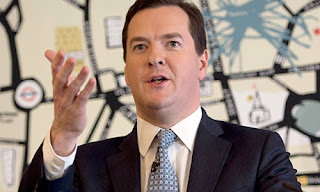
George Osborne welcomed the 0.3% growth figure announced by the ONS: 'Britain is recovering and we are building an economy fit for the future.'
"If we're to have a strong and sustained recovery and catch up all the ground we have lost over the last few years, we need urgent action to kickstart our economy and strengthen it for the long term – as Labour and the IMF have warned," Balls said.
According to the detail of the ONS's figures, the upturn in GDP was driven by growth of 0.6% in the key services sector, which includes retail and transport and makes up more than three quarters of the economy.
Industrial production also expanded, by 0.2% – though much of that was accounted for by rising North Sea oil and gas production. Activity in the hard-hit construction sector declined by 2.5%.
The business secretary, Vince Cable, said: "Today's figures are modestly encouraging and, taken alongside other indicators such as employment figures, suggest that things are going in the right direction."
Sterling hit its highest level against the dollar in two months after the news, rising by a cent and a half to $1.5450, amid speculation that the Bank of England will be less likely to expand its emergency quantitative easing programme against the background of a healthier economy.
"From a policy point of view, the signs that the UK economy may be growing, albeit weakly, are probably enough to put to rest any chance that the Bank of England would expand QE in May," said David Tinsley at BNP Paribas. Three of the nine members of the Bank's monetary policy committee voted for an expansion of QE at its April meeting.
A return to modest growth may also help to strengthen Osborne's hand in the tough negotiations with ministers over individual departmental spending plans, to be announced in June's spending review.
"Today's figure should provide some cover for the chancellor to continue on the path of fiscal austerity; we do not expect any major changes in the deficit reduction plan, at least this side of the general election," said George Buckley of Deutsche Bank.
However, Tony Dolphin, chief economist at the Institute for Public Policy Research, said the big picture revealed by yesterday's figures was one of an economy that was "stuck in a rut". The ONS said GDP was 2.6% below its pre-crisis peak in 2008, making the recovery weaker than that from any recession since the 1930s.
"Normally, we would expect the economy to grow by around 12% over any five-year period," said Dolphin. "The fact that it has contracted by 2.6% instead means almost 15% of potential output has been lost, along with the employment opportunities and tax revenues that would have accompanied it."
David Brown of New View Economics said: "The government have been very, very lucky. They have avoided a third dip into recession by the skin of their teeth. There is nothing to celebrate over as the UK economy is not out of the woods yet."
IMF officials are due to arrive in London next month to scrutinise the government's tax-and-spending policies, as part of its annual health check of the economy, after chief economist Olivier Blanchard accused Osborne of "playing with fire".
Dhaval Joshi of BCA Research said the government's continued commitment to austerity was in contrast to the shift in approach from the eurozone countries, with Greece, Spain and Portugal being given extra time to reach their deficit-reduction targets. He argued that planned cuts would depress growth more dramatically in the UK between 2012 and 2015 than in crisis-hit Italy or Spain.
"Just like the UK, the monetary union's third- and fourth-largest economies have been in extended, austerity-caused economic stagnations. But for Italy and Spain, peak austerity is now over," he said.
"The UK government shows no sign of budging from its plan A, while euro area policymakers are signalling a shift away from aggressive fiscal consolidation."
Despite the snow and unusually cold weather in the first three months of the year, the ONS denied that the weather had had much impact on the figures. While retailers suffered in January and March, that was partly offset by increased demand for energy from householders turning up their heating.
Azure is led by experienced Chartered Accountants and business advisers and specialises in providing online accountancy services to owner managed businesses.Azure Global’s vision is to be widely recognized as a reputed firm of financial business advisors, achieving real growth for ambitious companies and to become the first choice for F&A outsourcing for accountancy practices and businesses alike for more info visit our site Azure Global and join us On Facebook
Article source : http://www.guardian.co.uk