Showing posts with label JP Morgan. Show all posts

Thursday, 12 December 2013

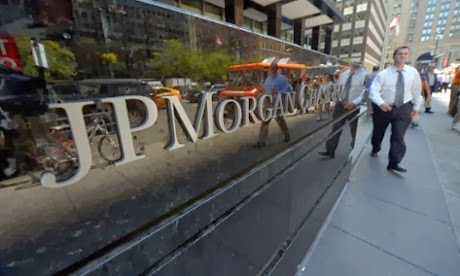
JP Morgan facing $2bn fine for involvement in Madoff ponzi scheme

Bank tentatively agreed to pay $2bn to settle allegations it failed to inform US authorities of the jailed fraudsters suspicious activity
JP Morgan Chase, the biggest bank in the US, is facing another multi-billion dollar fine, this time deriving from its involvement with notorious Ponzi scheme fraudster Bernard Madoff.
The bank has tentatively agreed to pay $2bn to settle allegations it failed to inform US authorities of the jailed fraudsters suspicious activity, according to people familiar with negotiations. A settlement deal with the Justice Department could come as early as next week. The bank declined to comment.
Madoff was arrested at his Manhattan penthouse five years ago this week after his $20bn scam came to light. JP Morgan was his bank for two decades and the US authorities suspect it continued to service his business even as it suspected something was wrong.
The fraudster himself predicted the bank would one day face a big fine. In a 2011 interview with the Financial Times he said: “JPMorgan doesn’t have a chance in hell of not coming up with a big settlement.” He claimed: “There were people at the bank who knew what was going on,” an assertion that JP Morgan has consistently claimed is false.
According to court papers filed by Irving Picard, the trustee charged with recouping losses for Madoff’s victims, the bank had grave doubts about Madoff 18 months before his scam unwound. The documents quote one banker claiming Madoff’s “Oz-like signals” were difficult to ignore.
The filings also quote a June 2007 email from a senior JP Morgan banker warning colleagues that another banker “just told me that there is a well-known cloud over the head of Madoff and that his returns are speculated to be part of a Ponzi scheme.”
The bank filed a “suspicious activity” report with UK authorities in 2008 but did not take a similar step in the US.
JP Morgan has always denied wrongdoing and disputes Picard’s findings but this week chief executive Jamie Dimon signalled that a deal was in the offing and suggested it was easier for the bank to settle than to fight its corner in court. “You read about Madoff in the paper the other day. We have to get some of these things behind us so we can do our job,” he told a conference in New York on Wednesday, first reported by the Financial Times.
According to a report in the New York Times on Thursday, the settlement would include a so-called deferred-prosecution agreement. Such an agreement would list all of JP Morgan’s alleged criminal wrongdoings but stop short of an indictment as long as the bank acknowledges wrongdoing and pays the fines.
The agreement would be the second time in a month that JP Morgan has been forced to acknowledge wrongdoing. On November 19 the bank paid a record $13bn to settle charges that it routinely bundled poor quality home loans into securities that were billed as high-quality to investors. That settlement too required the bank to own up to wrongdoing, something Wall Street has fought against for fear of triggering more shareholder lawsuits.
If the fine comes before Christmas it will cap an annus horribilis for JP Morgan. Alongside the $13bn fine for its involvement in the subprime loan scandal, JP Morgan has:
  • paid $4.5bn in November to settle allegations it has mis-sold mortgage bonds to pension funds and other institutional investors;
  • paid $920m in September to settle US investigations into the “London Whale” trading scandal;
  • in the same month, paid another $390m in refunds and $80m in settlement for billing credit card customers for identity theft protection they did not receive;
  • paid $410m in penalties and repayments in July related to alleged manipulation of California and midwest electricity markets;
Investors, however, have largely discounted the historic scandals and the bank’s share price is currently close to a year high.
Azure Global’s vision is to be widely recognized as a reputed firm of financial business advisors, achieving real growth for ambitious companies and to become the first choice for F&A outsourcing for accountancy practices and businesses alike and if u want to Setup ur business in United Kingdom then  its not difficult in this modern age for more info visit our site Azure Global and join us also On Facebook

Tuesday, 3 December 2013

JP Morgan paid £7m by Co-op Bank for recommending Britannia deal

Regulators should investigate how banks are paid for takeover advice, says Treasury select committee chairman
Regulators should investigate how investment banks are paid for takeover advice, according to the head of the Treasury select committee, after JP Morgan revealedit received £7m for advising the Co-op Bank on its disastrous merger with Britannia Building Society.
The US bank would have received nothing if the deal had not gone ahead, the bank revealed to MPs.
Members of the Treasury select committee said the investment bank had given "a green light" to Co-op'smanagement to do the deal which generated a multimillion pound fee for the US bank.
Tim Wise, one of JP Morgan's top bankers, admitted that the Britannia merger had worked out badly but insisted his bank's advice was sound at the time and that he would never be swayed by the prospect of a large fee.
However, the committee's chair, Andrew Tyrie, said after the hearing that regulators should scrutinise how investment banks are paid for orchestrating takeovers. "A fee structure for the provision of independent advice that heavily incentivises one outcome over others strikes me as inherently problematic. The industry and the regulators will need to look closely at the way such advice is remunerated," he said.
JP Morgan was the financial adviser on the Britannia deal which was announced in early 2009 when the financial system was on the brink of breakdown. Hailed at the time as creating a "super-mutual" to take on the big banks, the deal nearly wrecked the Co-op Bank this year when problem loans surged in Britannia's corporate loan book. Faced with a £1.5bn capital shortfall, the bank is undergoing a restructuring that will see 70% of the business handed to bondholders including US hedge funds.
The investment bank was paid £2m when the Britannia merger was announced and another £5m when the deal completed. Wise admitted the fee was "very significant" but he said clients preferred to pay investment banks success fees instead of smaller guaranteed amounts.
Tyrie told Wise it was "a shed load of money" and added: "It is asking for the objectivity of a saint not to be biased in thinking, as you prepare this advice, that you would like to see one outcome over another."
Stewart Hosie, a Scottish Nationalist member of the committee, read out a letter from JP Morgan to the Co-op board that said: "The terms of the proposed transaction are fair from a financial point of view for the Co-op."
Hosie said: "That is effectively giving the Co-op a green light to proceed."
Wise said it was up to the Co-op's management to use its own commercial judgment in deciding to do the deal.
Under repeated questioning about how large fees might skew investment bankers' advice, Wise said: "I'm afraid I have complete confidence in my own integrity and the impartiality of my advice."
He admitted the public might not agree and said there should be a debate about how investment banks are paid.
Wise said: "I don't think JP Morgan will suffer any reputational damage. Whether we will suffer personal reputational damage … time will tell."
Wise and Conor Hillery of JP Morgan said Co-op's merger with Britannia was undone by the prolonged economic downturn, which hit Britannia's commercial property borrowers, and by the City regulator's decision to tighten its capital rules.
The result was a £1.5bn hole in the Co-op Bank's finances that forced it to raise new cash from its bondholders and to scrap a second proposed deal to buy 631 branches from Lloyds. The group has cleared out its management and its former chairman has been exposed for alleged use of Class A drugs.
Wise admitted JP Morgan "undercooked" its assessment of the Britannia deal's riskiness but he said its tests included stressed scenarios devised by the Bank of England.
Separately, partners from KPMG told the MPs they were paid £1.3m for their work on the Britannia merger.
KPMG's early "due diligence" of Britannia for the Co-op did not include the corporate loans because the information was not available, they said.
KPMG partner Andrew Walker said he told the Co-op to scrutinise the corporate loans in its "phase two" work on Britannia, which the bank carried out itself.
Tyrie said the committee had been subjected to a "straight bat" by KPMG, which has audited the Co-op for 30 years.
Azure Global’s vision is to be widely recognized as a reputed firm of financial business advisors, achieving real growth for ambitious companies and to become the first choice for F&A outsourcing for accountancy practices and businesses alike and if u want to Setup ur business in United Kingdom then  its not difficult in this modern age for more info visit our site Azure Global and join us also On Facebook

Wednesday, 27 November 2013

Tesco's grim trading update will prompt questions about chief's strategy

Tesco is expected to unveil another grim trading update next week which is likely to prompt new questions about whether the turnaround strategy of chief executive Phil Clarke is working.
A flurry of City analyst research notes out yesterday predicted disappointing sales data when the UK's biggest grocer reveals its third quarter sales update. Barclays, Shore Capital and Deutsche Bank all expect no progress in the grocer's crucial UK market - which still accounts for 70% of group profits - after flat sales at the time of the last update.
Retail analyst James Collins at Deutsche Bank, Tesco's joint house broker, is forecasting a 1.5% decline in the most recent like-for-like UK sales.
He said: "We expect third-quarter like-for-like trends to have deteriorated in most markets versus the second quarter, most notably in the UK, Thailand, Ireland and Korea."
Barclays' James Anstead is predicting a 1.8% drop. He said: "It seems unlikely that Tesco's third quarter trading statement will be the turning point that the market is looking for."
Shore Capital's Clive Black is expecting a sales decline of 1-2%.
Tesco was one of the biggest FTSE-100 fallers. The shares lost more than 2.5% to close at 345p. Two years ago they were changing hands at 405p. JP Morgan yesterday cut its price target from 335p to 315p, Deutsche Bank reduced its target from 405p to 386p.
Tesco's main problems are in the UK, where it is losing business to upmarket rivals like Waitrose and the hard discounters, especially Aldi and Lidl. It is also struggling to catch up with a move away from big weekly shopping trips to out-of-town hypermarkets and a shift to online shopping.
Last week research group Kantar reported that all four of the big UKsupermarkets were losing market share, for the first time in more than a decade.
Clarke is 18 months into a £1bn transformation plan for Tesco's UK stores, which ranges from employing more store staff to revamping tired hypermarkets, improving the food on the shelves and trying to make faster headway in online shopping.
In an interview with the Sunday Times last weekend, Tesco's chairman Sir Richard Broadbent admitted the grocer had become too inward-looking over recent years and "had lost touch with the outside world". He said that a turnaround would not be rapid and that innovation - such as Tesco's new Hudl tablet computer - was key to the retailer's revival.
But at Tesco's last financial results it became clear that the grocer also has substantial problems overseas. Clarke, who led the international business before he took over the top job, reported declining like-for-like sales in every one of its international markets, which spread from Turkey to Thailand. Profits in Europe were down more than 70%.
Article Source : http://www.guardian.co.uk
Azure Global’s vision is to be widely recognized as a reputed firm of financial business advisors, achieving real growth for ambitious companies and to become the first choice for F&A outsourcing for accountancy practices and businesses alike and if u want to Setup ur business in United Kingdom then  its not difficult in this modern age for more info visit our site Azure Global and join us also On Facebook

Wednesday, 20 November 2013

JP Morgan Chase agrees record $13bn settlement charges over toxic mortgages

Bank acknowledges it made serious misrepresentations to the public over the sale of numerous mortgage-backed securities
JP Morgan Chase, the biggest bank in the United States, agreed a record $13bn settlement with regulators on Tuesday, ending months of tense negotiations with the Justice Department over a string of investigations into its risky mortgage deals.
The fine, the biggest civil settlement with any single company, ends several investigations and lawsuits brought by the US authorities related to the sale of home loan bonds between 2005 and 2008. It is more than four times the previous record $4bn fine the US levied against BP for the Deepwater Horizon oil spill.
Settlement talks have been fraught and lengthy. JP Morgan chief executive Jamie Dimon went to the US Justice Department to personally negotiate with attorney general Eric Holder in September, a personal summit that led some critics to claim that Holder was giving the bank special treatment. Tuesday’s agreement staves off a costly and potentially embarrassing trial.
As part of the settlement, JP Morgan acknowledged it made serious misrepresentations to the public – including to investors – about numerous transactions relating to residential mortgage-backed securities. The deals collapsed in 2008 when the housing market plunged and the scale of the risks was exposed, and the resulting financial tumult led to the biggest crisis since the Great Depression.
The admission was a major victory for the Justice Department. Banks have fought shy of such statements fearing yet more legal actions from investors. The settlement leaves open the possibility of potential criminal charges.
“Without a doubt, the conduct uncovered in this investigation helped sow the seeds of the mortgage meltdown,” said Holder. “JP Morgan was not the only financial institution during this period to knowingly bundle toxic loans and sell them to unsuspecting investors, but that is no excuse for the firm’s behavior.”
“The size and scope of this resolution should send a clear signal that the Justice Department’s financial fraud investigations are far from over. No firm, no matter how profitable, is above the law, and the passage of time is no shield from accountability,” Holder said.
The settlement was negotiated through the residential mortgage-backed securities (RMBS) working group, a joint state and federal initiative formed in 2012 to investigate wrongdoing in the mortgage-backed securities market prior to the financial crisis. Holder said the group’s investigations were “ongoing”.
John Coffee, a Columbia law school professor, said the fine was in marked contrast to the $1.9bn penalty Holder brought against HSBC for money laundering last December. “In that case he seemed to suggest some institutions were ‘too big to jail’,” said Coffee. In this case, Coffee said, Holder was still looking to bring charges against individuals in the future.
Coffee said the US authorities had so far struggled to charge senior individuals over the excesses of the financial crisis. “But the government is still looking. We may yet see another shoe drop,” he said.
JP Morgan sailed through the financial crisis relatively unharmed, but has been beset by legal woes in the crisis's aftermath. The fine is the latest, and largest, in a series that has led for some shareholders to call for Dimon’s resignation despite the bank's financial success and its solid share price:
• Earlier this month, the bank paid $4.5bn to settle allegations it has mis-sold mortgage bonds to pension funds and other institutional investors.
• In September, the company paid $920m to settle US investigations into the “London Whale” trading scandal.
• In the same month, JP Morgan paid another $390m in refunds and $80m in settlement for billing credit card customers for identity theft protection they did not receive.
• In July, the bank paid $410m in penalties and repayments related to alleged manipulation of California and midwest electricity markets.
The latest fine stems in large part from allegations of mis-selling of “toxic” mortgage securities by Bear Stearns and Washington Mutual, two firms JP Morgan purchased during the 2008 financial crisis at the behest of the government.
Of the $13bn resolution, $9bn will be paid to settle federal and state civil claims by various entities related to RMBS.
The heavily trailed agreement appears to have been delayed by arguments over the consumer-relief component of the pact that constitutes the remaining $4bn of the deal. That money will be used to reduce urban blight in areas such as Detroit, where the sub-prime crisis worsened an already struggling housing market and left many homes abandoned. They money will also be used to offer lower rate loans to low-income home buyers.
About $1.4bn will go to the National Credit Union Administration. “Today’s announcement by the Justice Department is extraordinary, and will greatly benefit credit unions that have been paying for the losses caused by the financial institutions covered by this settlement,” NCUA chairman Debbie Matz said.
Brian Kettenring, executive director of the Campaign for a Fair Settlement, said the size of the settlement was a “show of progress toward holding banks accountable for repeatedly breaking the law.”
“Criminal prosecution is still needed to deter future crimes. But more and likely better relief for struggling homeowners is a hard-earned victory for people across the country who have spoken out—and even gone to jail—demanding an end to Wall Street impunity,” he said.
Deborah Castillo, a member of pressure group Home Defenders League who lost her home to foreclosure said: “JPMorgan Chase should halt foreclosures while the settlement is implemented and make a good faith work with the homeowners in our communities who need fair modifications. I hope that funds from this settlement will quickly get to homeowners, who have waited far too long for relief, and are really used to help the families who are struggling and prevent the crime of more empty houses in our communities.”
While this agreement ends a troubled chapter for the bank, other issues remain. A criminal investigation of the bank over mortgages will continue. The bank is also under scrutiny for its hiring practices in China, its massive “London Whale” trading losses and its relationship with Bernie Madoff, the Ponzi scheme fraudster.
Article Source : http://www.guardian.co.uk
Azure Global’s vision is to be widely recognized as a reputed firm of financial business advisors, achieving real growth for ambitious companies and to become the first choice for F&A outsourcing for accountancy practices and businesses alike and if u want to Setup ur business in United Kingdom then  its not difficult in this modern age for more info visit our site Azure Global and join us also On Facebook
Wednesday, 13 November 2013

Royal Bank of Scotland faces further fines over sub-prime mortgage crisis

UK Financial Investments outgoing chairman says RBS has been forced to hold more capital because of potential penalties
Royal Bank of Scotland is still facing potentially painful penalties from the US authorities over the sub-prime mortgage crisis, the Treasury select committee of MPs was warned on Tuesday.
Already hit by a £390m fine for rigging Libor and in discussions with regulators over an investigation into potential currency rigging, the bank has been forced to hold more capital by the Bank of England because of the possibility of further fines, MPs were told by Robin Budenberg, the outgoing chairman of UK Financial Investments (UKFI).
Budenberg, who was challenged about the influence the Treasury has over the body which was set up look after the stakes in the bailed out banks, said mortgage trading was one of the outstanding issues RBS faces. He made reference to JP Morgan, which has paid £8bn to settle a number of regulators' claims it missold mortgages. "We've asked them where they feel their exposures are and clearly there are a range of regulatory issues that are pending," Budenberg said.
Earlier this month RBS admitted it was holding more capital and putting £38bn of its most troublesome loans into an internal bad bank after a review commissioned by George Osborne ruled out a full-blown standalone bad bank.
Budenberg admitted he had accelerated Stephen Hester's departure from RBS in September. The MPs were told that UKFI had not seen opportunities for a sale of the 81% government stake in RBS in the last two years – which appeared to contradict remarks by the bank a year ago when it raised the possibility of sale in 2014.
Budenberg's successor, James Leigh-Pemberton, indicated that the average price at which the taxpayer bought its stake in RBS – 502p – would not be the only consideration when deciding whether to sell anyshares. "It is difficult not to take it into account but it can't be the only consideration, because when we make our recommendations we also provide it in the context of whether there is an opportunity to realise fair value or more than fair value ," he said.
Leigh-Pemberton said it was "very, very difficult to say with any precision" when a sale of RBS could begin, and it would not be before the £1.5bn dividend access share, which allows the government to receive dividends before other shareholders, is removed.
To demonstrate UKFI's independence from Osborne, Budenberg said he had resisted deep cuts to bonuses suggested by the chancellor on the grounds the reductions were not "commercially acceptable". Budenberg also cited UKFI's influence in convincing Osborne not to force RBS to sell off its US arm, Citizens, too quickly. Citizens is to be spun off next year, probably through a stock market flotation.
"Our view has always been that we need to give Citizens time to recover in terms of its financial performance, and now is a time to begin that process," said Budenberg.
He is to leave at the end of the year after overseeing the sale of the first part of the stake in Lloyds – 4.2bn shares worth £3.2bn – in September at a price of 75p a share. Budenberg said the government could raise another 0.5p per share, or £21m, if more short-term investors, such as hedge funds, had been allowed to participate in the sale.
Budenberg said that UKFI wanted to show it was a responsible seller and that it does not "just sell to the highest bidder".
Further details would be released by the National Audit Office, Budenberg said.
Article Source : http://www.guardian.co.uk
Azure Global’s vision is to be widely recognized as a reputed firm of financial business advisors, achieving real growth for ambitious companies and to become the first choice for F&A outsourcing for accountancy practices and businesses alike and if u want to Setup ur business in United Kingdom then  its not difficult in this modern age for more info visit our site Azure Global and join us also On Facebook

Friday, 8 November 2013

Goldman Sachs co-operates with foreign exchange trading inquiry

Bank joins JP Morgan, RBS, Citigroup and others involved in inquiry into potential rigging of currency benchmarks
Goldman Sachs has become the latest bank to admit it is co-operating with regulators over an inquiry into potential manipulation of the foreign exchange markets, where more than £3tn of currencies change hands each day.
In a quarterly regulatory filing with US Securities and Exchange Commission, the biggest investment bank in America added currencies and commodities to the list of items with which it is in discussions with regulators.
The bank also set aside a further $500m (£311m) to cover potential litigation in reviews by regulatory bodies.
Two other US banks – JP Morgan and Citigroup – have said they are involved in the global investigation into potential rigging of currency benchmarks. Barclays, RBS, UBS, Deutsche Bank are among the European banks also co-operating with regulators.
The announcement by Goldman came as the London Metal Exchange took steps to tackle concern about queues at its warehouses, used to store metals traded on its exchange. Reuters reported that the measures were to counter criticism that firms such as Goldman Sachs have been artificially inflating waiting times and queues to boost rents for warehouse owners and cause metal prices to rise.
Article Source : http://www.guardian.co.uk
Azure Global’s vision is to be widely recognized as a reputed firm of financial business advisors, achieving real growth for ambitious companies and to become the first choice for F&A outsourcing for accountancy practices and businesses alike and if u want to Setup ur business in United Kingdom then  its not difficult in this modern age for more info visit our site Azure Global and join us also On Facebook

Friday, 25 October 2013

Royal Mail was worth £10bn, said JP Morgan. It sold for £6bn less

Investment bank gave valuation before flotation, as unions accuse government of 'conspiracy against taxpayer'
News of the valuation from JP Morgan re-ignited the huge row over the privatisation with Billy Hayes, the postal workers union leader, claiming a "conspiracy against the taxpayer" and demanding the sacking of Vince Cable as business secretary.
The government sold shares in Royal Mail for 330p each, valuing the business at £3.3bn on 11 October. But the shares rocketed in value by almost 40% that day alone and closed at 529p, making the company worth more than £5bn.
The official float figure excluded around £800m of debt, which included would give the state-owned business an "enterprise value" of £4.1bn but still almost £6bn lower than the price tag suggested by JP Morgan.
The US bank declined to comment but well-placed sources confirmed the figure of £10bn and made clear that others pitching to sell the Royal Mail on behalf of the government had also priced the mail company as high as £7bn.
The Department of Business said a whole range of different price tags had been put on Royal Mail at different stages of the sell-off process which was conducted in the most thorough way. "The banks' proposals came months before any threat of strike action by the unions, financial market uncertainty in the United States and other factors which the government has already said were taken into consideration in setting a price for the company in September," said a spokesman.
Hayes, the general secretary of the Communication Workers Union, said: "On the opening day of the flotation Vince Cable wrote off the undervaluation as froth. A week later, we were told it was the fault of the CWU. We now have a prima facie case of a conspiracy against the UK taxpayer who were opposed to the sale and have now been robbed of billions. In any other walk of life this would be a sacking offence and we call on Vince Cable to resign. A full inquiry should be launched into the mis-handling of this unnecessary privatisation by Vince Cable. We would also like the matter to be referred to the public accounts committee to scrutinise how badly the taxpayer has been left out of pocket.
Chuka Umunna, the shadow business secretary, said the development only added to fears that taxpayers have been significantly "short-changed by David Cameron's Royal Mail fire sale".
He added: "Vince Cable has said that taxpayer value was 'central' to the government's strategy in selling Royal Mail but given the extensive consultation with institutional investors and banks which took place, both he and the prime minister have serious questions to answer.
"Crucially, they must explain when the Government was made aware that the sale was so massively oversubscribed by major investors and why, having considered a higher price, they rejected that option.
"We have called for a full investigation into this matter so it is welcome that the National Audit Office has announced it will be looking into the deal and publishing its findings in the Spring."But Whitehall sources said it was not surprising that banks pitching for business might overplay the value of Royal Mail in the hope that they would win the work. They said it was like an estate agent coming round to have a look at a house and trying to persuade the owners to hire them by offering the best price available, but without the full knowledge at that point of all the circumstances.
Over 21 investment banks offered their services in May and their appointment was overseen by another City institution, Lazard. The spokesman for the Department of Business added yesterday: "The proposals included indicative valuations of the company based, in many instances, solely on information already in the public domain. Banks made their own assumptions of Royal Mail's future performance. The range was wide with the median around £3.6bn taking into account [an] IPO [initial public offering] discount." Among the banks that did win the work were Goldman Sachs and UBS.
Article Source : http://www.guardian.co.uk
Azure Global’s vision is to be widely recognized as a reputed firm of financial business advisors, achieving real growth for ambitious companies and to become the first choice for F&A outsourcing for accountancy practices and businesses alike and if u want to Setup ur business in United Kingdom then  its not difficult in this modern age for more info visit our site Azure Global and join us also On Facebook

Sunday, 20 October 2013

JP Morgan close to agreeing $13bn settlement with US authorities

Settlement is greater than the expected $11bn and does not release the JP Morgan from any criminal liabilities
America's largest bank, JP Morgan, is close to finalising a $13bn (£8bn) record settlement with the US authorities over a number of issues related to the subprime mortgage crisis.
The settlement, described as tentative in some reports, is even greater than the $11bn that had been expected and is said not to release the bank from any criminal liability. It would also be the largest ever between the US government and a single company.
The bank's chairman and chief executive Jamie Dimon had been involved personally in the discussions with the US Department of Justice and this month JP Morgan admitted it had incurred legal expenses of $9.2bn from regulatory investigations and lawsuits.
In total the bank has put aside $23bn for potential litigation since 2010 – and has warned this could rise by a further $6.8bn – in moves that illustrate the stunning reversal in fortunes of a bank that had survived the banking crisis relatively unscathed.
JP Morgan now faces more than a dozen investigations globally – from alleged bribery in China to a possible role in manipulating benchmark interest rates set in London known as Libor.
Dimon had steered the bank through the financial crisis without ever reporting a quarterly loss, but that record ended this month when he had to admit that legal expenses drove the firm to a loss of $400m.
The latest settlement relating to mortgage-backed securities follows a fine of more than $900m from a number of authorities over last year's London Whale trading incident, which Dimon had originally attempted to brush aside as "tempest in a teapot".
The Whale episode also lost the bank $6.2bn and Dimon's bonus was halved as a consequence.
At issue in the latest settlement is whether the bank sold mortgages that it knew were riskier than they appeared. Investors, including government-owned mortgage agencies Fannie Mae and Freddie Mac, said that the bank told them loans were safer than they were, or that the bank was negligent in not verifying information from borrowers relating to their income and their ability to repay the debt.
A sizeable chunk of the $13bn relates to customer redress. According to Bloomberg the settlement includes $4bn to the Federal Housing Finance Agency – which incorporates Fannie Mae and Freddie Mac.
Dimon secured the tentative deal in a meeting with the justice department's attorney general, Eric Holder, according to CNBC. Steve Cutler, the bank's general counsel, and Tony West, Holder's deputy, were said to be involved.
Dimon and Holder had met face-to-face in Washington last month. A well-connected figure in financial and political circles, Dimon took the helm of JP Morgan in December 2005. He is now running the biggest US bank in terms of assets.
As well as surviving the financial crisis, the banker has also resisted calls to split his joint roles at the bank.
The settlement is partly the result of JP Morgan saving two firms – Bear Stearns and Washington Mutual – which account for about 80% of the securities involved in the $13bn fine. The US government encouraged JP Morgan to rescue both institutions as they were collapsing during the financial crisis.
This month the bank said Dimon was no longer chairman of JP Morgan's main US retail banking subsidiary.
JP Morgan did not comment, and the US department of justice could not be reached.

Ongoing tempest

For all his smooth talking, it is likely that the most memorable line to emerge from the career of JP Morgan boss Jamie Dimon will be his crack about a "tempest in a teapot". That was his attempt to dismiss reports of problems in the bank's London office, where it turned out that his traders had lost $6bn.
The comment was perhaps the result of confidence gleaned from years of uninterrupted success, which included being one of the few bankers to emerge from the financial crisis with an enhanced reputation. However, the pressure is now increasing on Dimon as he wrestles with a string of legal complaints.
This was not how it was all meant to be, as Dimon has long appeared to have led a blessed life.
A protege of former Citigroup boss Sandy Weill, who is often described as a "Wall Street legend", he graduated as a Baker scholar from Harvard Business School, an honour given only to the top 5% of the graduating MBA class. His classmates included GE boss Jeff Immelt, and Dimon's future wife, Judy.
Article Source : http://www.guardian.co.uk
Azure Global’s vision is to be widely recognized as a reputed firm of financial business advisors, achieving real growth for ambitious companies and to become the first choice for F&A outsourcing for accountancy practices and businesses alike and if u want to Setup ur business in United Kingdom then  its not difficult in this modern age for more info visit our site Azure Global and join us also On Facebook

Thursday, 26 September 2013

JP Morgan boss in talks over penalty fine for sub-prime bond sales

Bank's Jamie Dimon may have to settle on record $11bn penalty following recent $920m fine over 'London Whale' incident
The boss of America's biggest bank, JP Morgan, was on Thursdaypersonally negotiating a new financial settlement with US regulators over allegations stemming from the way the bank sold sub-prime mortgage bonds before the banking crisis. The settlement could reach a record $11bn (£7bn)
Jamie Dimon, one of the few bankers still at the helm of a big bank following the 2008 financial meltdown, turned up for face-to-face talks with the US attorney general, Eric Holder, at the department of justice in Washington. The negotiations prompted fresh speculation that Dimon will be forced to agree to a payout bigger than the $4.5bn paid by BP over the Gulf of Mexico oil spill.
There are suggestions JP Morgan could be forced to make $4bn of payments to consumers and $7bn of penalties to cover losses incurred from the way mortgages were packaged by JP Morgan as the financial crisis took hold.
The new payout negotiations come only a week after JP Morgan was fined $920m by regulators in the US and the Financial Conduct Authority in Britain over the $6.2bn trading losses that became known as the "London Whale" incident a year earlier.
In an unusual move, JP Morgan admitted wrongdoing and was accused of "unsafe and unsound practices" in derivatives trading taking place in the so-called chief investment office. On the same day the bank was forced to hand over $390m in fines and refunds for overcharging credit card customers.
If the new payout reaches $11bn the bank will have had to pay $30bn in fines and settlements over the past four years. It has already incurred $17.3bn in regulatory fines in the three years to 2012 and in recent regulatory filings – which contain 10 pages of legal disclosures – the bank estimated it faced a possible $6bn of further costs. The sums being discussed in Washington would be well in excess of that figure.
The timescale for concluding the discussions is so far unclear owing to the complexity of the issues and the number of US authorities involved. They include not just Holder's justice department but also the New York attorney general, the securities and exchange commission and federal housing departments.
During the crisis, JP Morgan stepped in to take over Washington Mutual and Bear Stearns and Dimon was viewed as one of the only bankers to have escaped the crisis with his reputation intact. However, the string of punishing regulatory scandals has now put him under pressure.
When US prosecutors levelled criminal charges against former JP Morgan traders in relation to the Whale incident, Preet Bharara, New York attorney general, said: "This was not a 'tempest in a teapot' [a phrase used by Dimon to describe the incident when it emerged], but rather a perfect storm of individual misconduct and inadequate internal controls."
After the Whale fine, Dimon warned that "in the coming weeks and months we need to be braced for more to come" amid speculation that his relationship with regulators is deteriorating.
Even if a settlement can be reached over the way sub-prime mortgages were packaged and sold to investors ahead of the banking crisis, JP Morgan faces a string of other potential wrangles. It is not clear if some of these could be part of the current talks.
Some of the problems related to the takeover of Bear Stearns and Washington Mutual which were big players in the once lucrative business of packaging up mortgages into what looked like safe investments. When the credit crunch hit in 2007 the value of these products collapsed and left holders with large losses.
Dimon, who earlier this faced down calls for his roles as chairman and chief executive of the bank to split, has been softening the ground for hefty settlements in recent weeks. In a staff memo last week he wrote that since 2012 more than 4,000 extra staff had been assigned to risk, compliance, legal and finance departments with an extra $1bn being spent on controls. Staff have undergone 750,000 hours of training on compliance procedures.

JP Morgan fines and settlements: the last two years

2011 Hands over $228m to settle allegations that the bank manipulated the bidding process for municipal bonds
2012 Among five banks made to pay $25bn in penalties and compensation over the robo-signing scandal (illegal repossession procedures which evicted many people from their homes unecessarily or prematurely)
2013 Among 13 banks that have to pay $9bn in cash and other help to homeowners over the robo-signing scandal
2013 Hands over $920m in fines relating to its lack of internal controls in the wake of the $6bn trading loss run up by the "London Whale" trader
2013 Hands over $410m to settle allegations of manipulating the electricity market in California
2013 Hands over $390m in fines and rebates for overcharging credit card customers
Article Source : http://www.guardian.co.uk
Azure Global’s vision is to be widely recognized as a reputed firm of financial business advisors, achieving real growth for ambitious companies and to become the first choice for F&A outsourcing for accountancy practices and businesses alike and if u want to Setup ur business in United Kingdom then  its not difficult in this modern age for more info visit our site Azure Global and join us also On Facebook